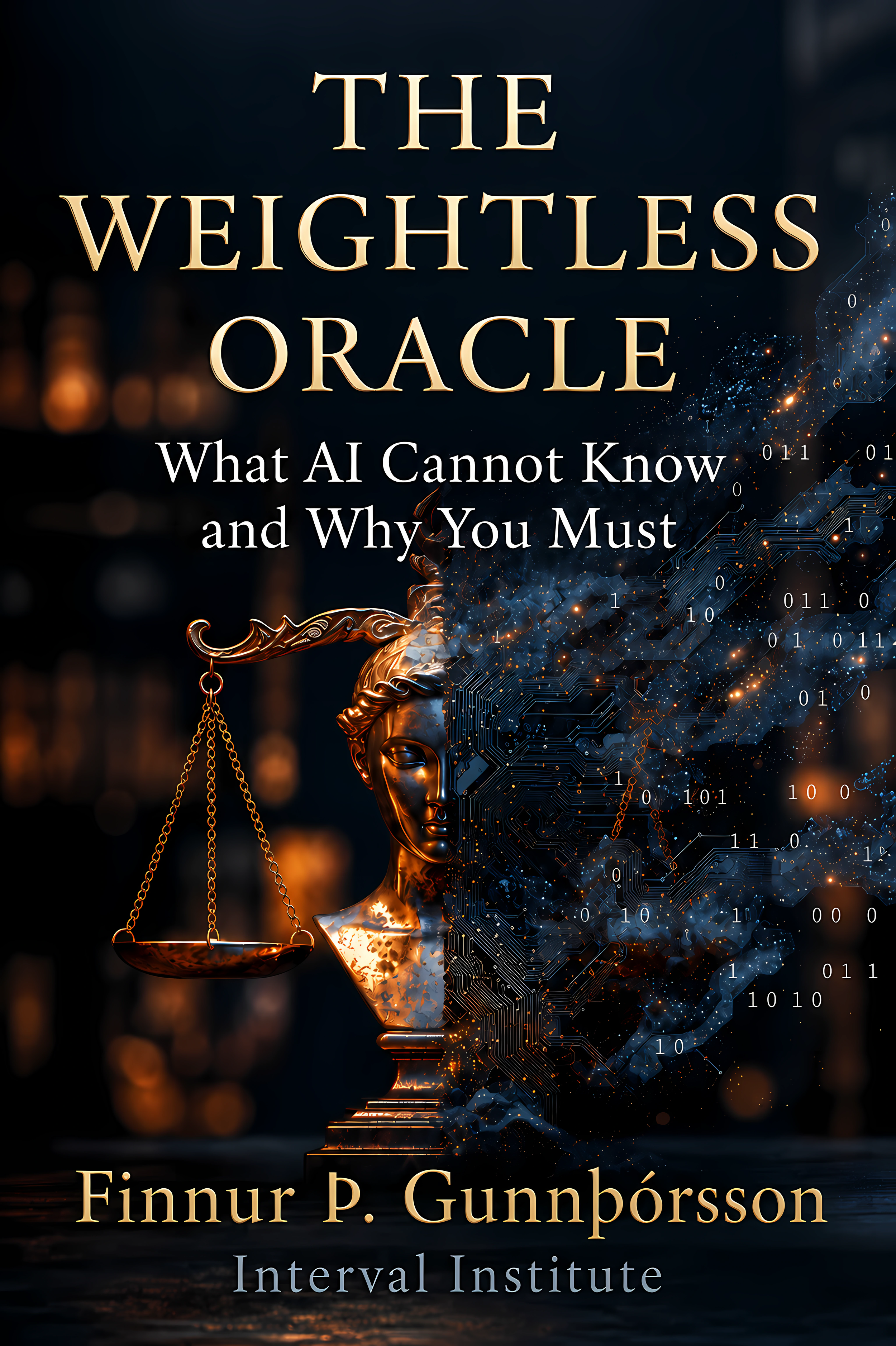
THE Weightless oracle
Interval Institute - 2026
AI did not create the exposure senior judgment now faces. It industrialized it. The Weightless Oracle traces how organizations built to serve a purpose quietly begin serving appearances instead — and what that costs the leader, the physician, the lawyer, the therapist, anyone whose judgment is meant to be trusted.
Published writing
The purpose of CSR reporting: from targeted stakeholder communication to holistic corporate branding
Master's thesis, Copenhagen Business School, 2005 (with Markus W. Berg)
Democratic involvement — what are the factors?
Developed for a session moderated at A Congress on Iceland's Democracy, UC Berkeley School of Law, 3 June 2017.
Later published in the WMO Conflict Insight. The essay is mine. The abstract, summary, solutions section and reference list are additions by the journal's editors; which mark their additions or changes with an asterisk. Many of them to various articles, including mine are usually helpful and provide an easy overview of scope and implications for solutions in mediation work.
I noticed for this essay of mine their addition on Ortega gets him backwards. It says the fix for specialization is a public that questions experts instead of deferring to them. From the editors: "On specialization, the corrective is not to distrust expertise but to change the relationship between experts and citizens: experts who present evidence and uncertainty to a deliberating public, and who are questioned by that public rather than deferred to, restore what Ortega feared was lost without discarding what specialists actually know." My take on that is:
Ortega's point is different and bigger than that, and it is not about arrogant people. He says specialists are made when science was cut into smaller and smaller pieces to keep advancing, until one person had to sacrifice to master only one small piece, and the pieces got so narrow that even a mediocre person could work one and still get real results, because the method carries him. His confidence rises with every result. His understanding of anything outside his piece does not rise at all. People used to divide into two kinds, the learned and the ignorant. He is a third kind. He genuinely knows his own corner but perhaps only as a protocol, he may not even know the true methodology of his science or its philosophical underpinnings. Meaning a scientist can modernly follow a protocol and have plenty of results without having a rigorous understanding of their meaning or foundations. Being blank everywhere else. And the confidence that comes from knowing his corner follows him into every subject he knows nothing about. He does not listen. He treats curiosity about anything outside his own subject as amateurism. Give him a questioning public and he will not listen to it either.
Ortega wanted something requiring more all encompassing human development: learn enough outside your corner to see the whole you work inside, and notice that the whole has to be kept alive on purpose, by real people, or eventually there is nobody left who can do the work at all. Without that, a person can be excellent at one thing and never notice that civilization was built on principles that are connected and has to be kept up.
The one that assumes civilization is just there, like the ground under his feet, is in the danger or eroding it. The danger is civilization stops being kept up when experts sacrifice so much of what it is to develop as a human for an ever narrower field of expertise, for the sake of competitiveness. Nobody decides to stop keeping it up. Nobody ever notices there was anything to keep up.
The loss is not only the narrow domain specialists. When everything has become somebody else's domain, the risk is that people defer to experts that have themselves become hallow rather than trust their own life experience, and learn to discount what they have lived, keeping everybody more infantile and eroding civilization. This is actually one of the main problems with our current "post-modern" or meta-modern civilization as seen in my book The Weightless Oracle.
Kjarninn, 10 February 2018 — more of a maverick writing style on economics and culture.
WMO Conflict Insight, ISSN 2628-6998, September 2019
Trade wars and the making of meaning
WMO Conflict Insight, ISSN 2628-6998, 7 November 2019
The Lebanese situation: the economic models of the world do not work
WMO Conflict Insight, ISSN 2628-6998, December 2019 (month approximate)
North Korea and the end of the world
WMO Conflict Insight, ISSN 2628-6998, February–March 2020
Mediation: crisis, postmodern culture and decision making
WMO Conflict Insight, ISSN 2628-6998, 3 July 2020. Also on SSRN, with DOI.
Mitigating the crisis in democracy: preemptive mediation and the survival of the planet
WMO Conflict Insight, ISSN 2628-6998, after July 2020
In the press
5 April 2016 — coverage of the Icelandic prime minister's resignation, Panama Papers
30 July 2016, syndicated by the Toronto Star, 3 August 2016
Documentaries - Interviews
Dir. Alex Gabbay, 2017
Dir. Ryslaine Boumahdi